Calligraphers and marketing teams will have a field day with this one!
Artdaily.org - The First Art Newspaper on the Net
Shared via AddThis
Friday, July 31, 2009

Monday, June 1, 2009
Rimini Antiphonal in glorious colour!
In 2007 the Rimini Antiphonal from the Richardson collection was re-photographed prior to the Medieval manuscripts exhibition at the State Library of Victoria. The 336 images have now been linked to the record - select the link ' Connect to select images'. The top link is to an older version of the Antiphonal which will be removed any second now. There is still work to be done placing the images in the correct order including the wooden binding but we are getting closer!

5. Folio 71r – Letter ‘E’ illustrating Christ blessing four saints

5. Folio 71r – Letter ‘E’ illustrating Christ blessing four saints
Sunday, May 31, 2009
Hagred's book of the month

 The rare book collections are receiving some well deserved attention in the Library's eRecords project. Recently completed are full records for all items in the Richardson collection of bibles, early printed books and manuscripts. A favourite item recently catalogued online is Vlyssis Aldrovandi patricii Bononiensis Serpentum, et draconu[m] historiae libri duo (Richardson /F289) published in 1640. This is a natural history of snakes and dragons!
Ulisse Aldrovandi ( 1522 - 1605) was an Italian naturalist and physician who observed and documented his fascination with birds, animals and minerals. The Richardson collection includes a number of books on natural history.
Locating all of the items in the Richardson collection is now possible with a basic subject search using the phrase 'Richardson Collection'.

Sunday, April 19, 2009
Fore-edge painting

The Boston Public Library has launched a new online exhibition. On the Edge - The Hidden Art of Fore-Edge Painting.
Fore-edge painting is where an image is painted on the fore-edge of the book. When the edges are fanned the image appears. When the book is closed the image disappears.
We have a number of fore-edge paintings in the collections, although there are only a few listed in the catalogue. Is this a case where cataloguing our older collections with the item in hand may mean we miss some fore-edge decorations? Unless we fan the item, would we know? Would the catalogue card be annotated?
We certainly haven't digitised images from any of our fore-edge paintings!
Sunday, March 8, 2009
What drives people to steal precious books?
This article from the Financial Times focuses on the theft of rare books. But what about the statement that ' “inside jobs” account for upwards of 70 per cent of all library theft in Europe and 80 per cent in the US.'
How do we feel about that statement and the idea of increased internal security? '...the Library of Congress in Washington, DC, where all staff including top directors are searched whenever they leave the building'.
How do we feel about that statement and the idea of increased internal security? '...the Library of Congress in Washington, DC, where all staff including top directors are searched whenever they leave the building'.
Sunday, February 1, 2009
Illuminating images
 I've been looking at some of the Books of Hours in the Library's collections. They vary from the highly ornate to the charmingly simple. A Book of Hours was used to guide the owner through a series of prayers and devotions across the day. This miniature of the Nativity is from a Book of Hours from c. 1500 ( ML Safe 1/7e). This scene of the Nativity is traditionally used to indicate Prime - around 6 am.
This image of the Announcement of Christ's Birth to the shepherds is from a late 15th century manuscript from Northern France ( ML Safe 1/7d. Look at the cheeky little grotesque under the image!


Monday, January 5, 2009
David Rumsey Map collection
With my imminent move to the Maps collections at the State Library, Rare diversions will be including maps as well as rare books!
The David Rumsey Map collections site is amazing and an incredible diversion. The link to Visual Collections is also interesting - ' View maps, fine artwork, photographs and other items from over thirty renowned collections '. There are some excellent examples of how technology can be used to highlight and improve access to historical and contemporary collections.
The David Rumsey Map collections site is amazing and an incredible diversion. The link to Visual Collections is also interesting - ' View maps, fine artwork, photographs and other items from over thirty renowned collections '. There are some excellent examples of how technology can be used to highlight and improve access to historical and contemporary collections.
Wednesday, December 24, 2008
Puddings from the John Hoyle Cookery Collection

In the Everylady's Cook-book (641.5994/120) published in 1938, Miss Drake suggests that as well as cooking the traditional Plum pudding 'because it is part of our Empire inheritance' we should also consider a Fruit and Nut Jelly or 'the 101 degrees in the shade Christmas Pudding', a mixture of raisins, walnuts, almonds, cherries, nutmeg, cinnamon and spice set in an amber jelly made with plenty of fruit juice or wine.

If you are looking for the Christmas Pudding which won first prize at the Melbourne Show you will need to consult Mrs. Floate's "secret of success" Cookery Book. Volume 2 (641.5994/141) published in 1945. Her secret seems to be the appropriate use of suet as well as figs, dates, orange marmalade, treacle and 12 eggs!
For something a little more complicated you may like to consult the 1939 edition of the Green and Gold Cookery Book(641.5994/140), first published in the 1920s, for the Happy Day Pudding.
Take two or more children, according to taste, one skyful of sun, one lawn ( fresh and green ), four trees ( shady ones preferred ), one nursemaid ( out of sight). Take the children, mix well with an armful of dolls, reins, rubber balls, one puppy, one tent, and one rocking horse. When mixed, sprinkle all over with smiles and a pinch of unselfishness. Keep stirring till sundown, then take the children, put in a cool room, cover lightly, and leave till morning.
Monday, December 22, 2008
Mark Catesby's Natural History of Carolina...

In 2001 the NSW Parliamentary Library raised over $500,000 through the sale of material from their collections. At the time the State Library was offered a number of significant items including the third edition of The natural history of Carolina, Florida, and the Bahama Islands ( RB/F/374-375) published in 1771.
The hand-coloured engravings in these beautiful volumes were created by English artist and naturalist Mark Catesby (1683-1749) who spent many years in North America drawing and documenting the animal and plant life.
The Catesby Commemorative Trust has produced a film on the life of Mark Catesby.
The Curious Mister Catesby from David Elliott on Vimeo.
The Catesby volumes were a significant addition to the impressive collection of works on ornithology already held by the Library including works by Audubon, Gould, Levaillant,Latham,Buffon and Lewin.
Monday, December 8, 2008
Monday, December 1, 2008
Thefts at the British Library
An article from the Guardian in the UK from November 21, 2008, describes the theft of single leaves from rare printed works in a number of Libraries in the UK, including the British Library and the Bodleian.
According to the article
According to the article
'Using electronic records, they found all the British Library members who had taken out the book and then examined other works these people had had contact with. They discovered that other works detailing the same periods in history and covering European engagement to the area from modern-day Syria to Bangladesh were also damaged.'

Without the ability to electronically request, circulate and examine transaction data on our collections how easily could we follow the trail of a suspected thief?
Wednesday, November 19, 2008
Handle this Book!
In Handle this Book! the New York Times describes the presentation of rare books and manuscripts to History undergraduates. There's nothing like the smell of old books, the sound as you flick through the pages of a book made from cloth paper or reading the scribbled notes and signatures of previous owners!
 This is the untidy scrawl of a previous owner of the 1640 edition of Parkinson's Herbal held in the Richardson Collection (263F). William Hopkins has practised his signature numerous times on the last page of the volume but what was he thinking when he scrawled the following lines...?
 This is the untidy scrawl of a previous owner of the 1640 edition of Parkinson's Herbal held in the Richardson Collection (263F). William Hopkins has practised his signature numerous times on the last page of the volume but what was he thinking when he scrawled the following lines...?
'Remember well and bear in mind
a faithful friend is hard to find
but how to find a friend so just
is first to try and then to trust'
a faithful friend is hard to find
but how to find a friend so just
is first to try and then to trust'
Virtually recreating the Library of Sir Hans Sloane
 A Press release from the Wellcome Trust and the British Library has announced the availability of the Sloane Printed Book Catalogue. This is a virtual reconstruction of the Library of Sir Hans Sloane ( 1660 - 1753) , one of Britain's most important collectors and founder of the British Museum. The comment by Alison Walker, Lead Researcher of The Sloane Printed Books Project...' We can learn much about Sir Hans Sloane, his career, and the intellectual and scientific circles in which he lived by looking at what material he acquired and how it was used, ' reminds us of how important it is that we continue the work from the David Scott Mitchell Project and include the provenance of items in our electronic records, particularly when they are related to significant people in the Library's history and the development of Australia.
 You can read about the collection and the project from the website. The detail on identifying and interpreting the provenance of items is interesting. I know I have seen items in the Library's collections with this British Museum stamp. If we looked closer would we also find a Sloane shelfmark?
On a lighter note, did you know that Sir Hans Sloane 'discovered' Milk Chocolate?
Sunday, November 2, 2008
An interactive timeline
This commercial site developed by Jeremy Norman has an amazing amount of information about the history of science, medicine and information. According to the 'blurb' on the site 'Historyofscience.com is more than a bookselling site. It is also about the culture of collecting the history of science, medicine, and technology.'
An interactive timeline now available on the site. It is a great resource for bits and pieces on rare books, printing, publishing!
Did you know that the first known medical work was printed in 1457. The Bloodletting calendar apparently listed the unlucky and lucky days to have your blood drained!
An interactive timeline now available on the site. It is a great resource for bits and pieces on rare books, printing, publishing!
Did you know that the first known medical work was printed in 1457. The Bloodletting calendar apparently listed the unlucky and lucky days to have your blood drained!
Saturday, October 25, 2008
Charlie Cheesecake
 The eRecords project will no doubt identify some rare and important items. The project will also bring to light curiosities and charming examples of how life used to be. In the Adventures of Charlie Cheesecake young children are warned not to go swimming straight after eating, are cautioned about hanging out the train window and not looking both ways before they cross the road.
We have two copies of this title. One is located with Children's literature the other copy with Children's health & hygiene. I'm not sure the modern advertising Executive would choose Cheesecake for the family name of the main character in a child safety campaign!
In the images below the author Marjorie Hann warns children not to run around with sharp objects in their mouth! Excellent advice!


Monday, October 13, 2008
I See Dead People's Books
LibraryThing has a group called I See Dead People's Books
'Description: A group for those interested and involved in entering the personal libraries of famous readers into LibraryThing as Legacy Libraries.'
Amongst the list of complete and incomplete libraries is one for Alfred Deakin. You can see a description of the Project which is based on a list held by the National Library of Australia.
Could this facility help to gather collections 0f other important Australian people? Books once owned by Ludwig Leichhardt, Samuel Marsden, Henry Gurner that have now been dispersed.
Just one thing from LibraryThing that I am not quite clear about. How can you find out the details of the item that have been added to the Legacy Library - which individual or Library holds the title?
Wednesday, October 8, 2008
NYPL Digital Gallery
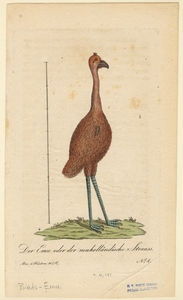
Looking for a Christmas gift or a new way to provide access and gain revenue from collections? The New York Public Library is redesigning their Digital Gallery. You can view the Digital Gallery Redesign Preview or take a look at Der Emu oder der neuholländische Strauss. (1803-1805) use the buttons at the top to resize, select and then create your own unique emu coffee mug!
Thursday, September 11, 2008
This book is a real stinker!
 Bloomsbury Auctions in New York has a really interesting item for sale. Full calf binding with an elaborate blind-tooling!
Wednesday, September 3, 2008
Fight to stop rare books sell-off
 According to an article on BBC News live, Tuesday, 2 September 2008, 'Cardiff Council could eventually sell up to 18,000 items dating from the 15th Century at auction to raise money for improvements in library services.'
Is this a dangerous trend? In 2003 Oriel College at Oxford University sold their copy of Shakespeare's First Folio to pay for building repairs and textbooks.
Friday, August 29, 2008
Wound man

This image of the Wound man is taken from the Library's copy of Feldtbuch der Wundartzney, by Hans von Gersdorff. Our copy was published in Strassbourg in 1540 although the first edition was published in 1517. Feldtbuch der Wundartzney is a medical text written for military surgeons. Along with illustrations of amputations, trepanning, cauterizing and palmistry we find the image of the Wound man which illustrates the various wounds suffered in battle or in accidents. The original woodcut was possibly drawn by Johannes de Ketham who published the first printed medical text Fasciculus Medicinae in 1491.
Hannibal Lecter, in the novel Red Dragon, uses the illlustration of the Wound man as a model for the arrangement of the body of his sixth victim.
From the call number, MRB/ Q617.99/ G (16th Century), you can see that this item is from David Scott Mitchell's original bequest and doesn't quite fit that obsession with Australian History.
Subscribe to:
Posts (Atom)


 Posts

